About my research

Kecia de Moura

Ph.D. in Engineering at ÉTS. I am currently a Ph.D. candidate in Engineering at École de technologie supérieure (ÉTS) in Montreal, Canada, where I am supervised by Prof. Rafael Menelau Oliveira e Cruz and co-supervised by Prof. Robert Sabourin, with my research supported through NSERC-funded projects. My current research lies at the intersection of machine learning, biometric verification, and data streams. My work has resulted in publications at major international conferences and journals, including receiving a Best Paper Award at ICPR 2024.

M.Sc. in Computer Science at UFPE. Before joining ÉTS, I completed my Master's degree in Computer Science at the Center of Informatics (CIn) of the Universidade Federal de Pernambuco (UFPE), in Recife, Brazil, where I was advised by Prof. Ricardo Bastos C. Prudencio and co-advised by Prof. George Darmiton Cavalcanti, supported by a CNPq scholarship. My master's research focused on machine learning, investigating label noise detection through ensemble-based filtering methods under distinct statistical noise models.

B.Sc. in Computer Engineering. I earned my Bachelor's degree in Computer Engineering from the Universidade Federal do Vale do São Francisco (UNIVASF), in Juazeiro-BA, Brazil, where I first became involved in scientific research through a CNPq-funded project focused on rainfall pattern characterization in the Sub-Médio São Francisco region. As part of this project, I developed a computational tool integrating database functionalities, graphical user interfaces, and statistical methods to support missing data imputation and homogeneity analysis. For my undergraduate thesis, advised by Prof. Ana Emilia de Melo Queiroz and co-advised by Prof. Ricardo Argenton Ramos, I developed GERARD, an educational software platform for teaching additive and multiplicative mathematical structures based on Gérard Vergnaud's Theory of Conceptual Fields. The software was later officially registered by the Brazilian National Institute of Industrial Property (INPI).

Publications

1
A Prototypical Signature Approach for Writer-Independent Offline Signature Verification

A Prototypical Signature Approach for Writer-Independent Offline Signature Verification

Kecia G. de Moura, Robert Sabourin, Rafael M. O. Cruz

arXiv preprint arXiv:2606.18528 2026 Preprint
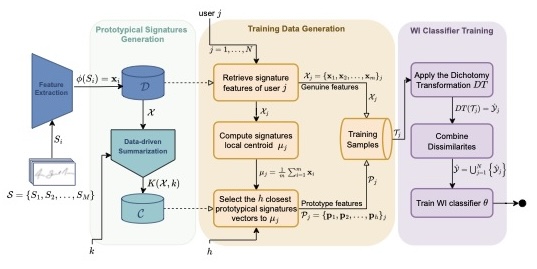
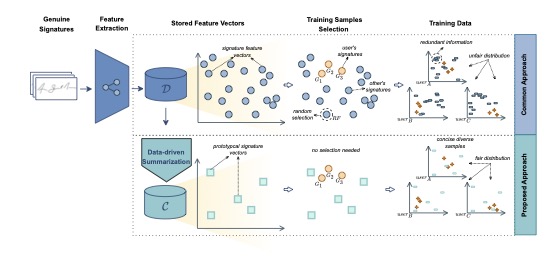
Offline handwritten signature verification aims to distinguish genuine from forged signatures using static images. Since real forgeries are rarely available, negative samples are usually randomly drawn from genuine signatures of other users to create training data. However, this random selection often lacks diversity, increases redundancy, and escalates computational cost, leading to inefficient training. We propose a data-driven strategy to generate diverse, informative negative samples using prototypical signatures, which are compact, non-identifiable summaries of genuine signature features. Based on the experimental results, we conclude that (i) prototypical signatures yield more informative negative samples, improving the detection of skilled forgeries; (ii) the proposed approach is backbone-agnostic showing robustness across architectures; and (iii) when combined with a primal-form linear SVM, it serves as an alternative to RBF-based models while significantly improving scalability and computational efficiency.
2
ProtoSig: Enhancing training data for offline handwritten signature verification using prototypical signatures

ProtoSig: Enhancing training data for offline handwritten signature verification using prototypical signatures

Kecia G. de Moura, Robert Sabourin, Rafael M. O. Cruz

Pattern Recognition 2026 Journal DOI
Offline Handwritten Signature Verification (offline HSV) analyzes static images of signatures to distinguish between genuine and forged samples. To create training data for such systems, negative samples, commonly known as random forgeries, are typically drawn from genuine signatures of other users, as real-world datasets often lack actual forgeries. While this strategy helps address the scarcity of forgery data, it faces several challenges. The randomly selected samples may lack the diversity and challenge needed to improve model robustness. Additionally, they can cause redundancy, increasing training time and storage requirements, and may introduce bias across users, leading to unfair training distributions. This paper proposes a novel strategy, called ProtoSig, for generating more informative and diverse negative samples by leveraging prototypical signatures, which are compact, non-identifiable vectors obtained through a data-driven summarization of signature feature vectors. Our experiments demonstrate that ProtoSig enhances skilled forgery detection in a writer-dependent verification approach, eliminating performance variability across runs, while reducing dependence on external user data. We further demonstrate that our method achieves comparable or higher accuracy with a smaller training set, yielding substantial scalability benefits: over 98% reduction in training time and up to two orders of magnitude lower computational cost (in FLOPs), while strengthening data privacy and promoting fairness in offline HSV systems.
3
Offline handwritten signature verification under a stream context with partially labeled data

Offline handwritten signature verification under a stream context with partially labeled data

Kecia G. de Moura, Rafael M. O. Cruz, Robert Sabourin

Pattern Recognition Letters 2026 Journal DOI
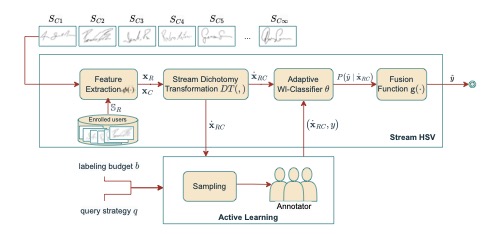
Handwritten signature verification is a biometric authentication task that distinguishes genuine from forged signatures. Traditional offline methods rely on batch learning, which struggles with signature variability and limited labeled data. Recent advances in stream-based approaches have improved adaptability but still depend on fully labeled training data, which is impractical for real-world applications. This paper extends prior work by introducing a framework that integrates partially labeled data with active learning to enhance verification performance in a streaming context. We introduce a novel query strategy based on the k-disagreeing neighbors score, which prioritizes ambiguous samples near decision boundaries. Experimental results demonstrate that the proposed approach adapts to new signature variations while improving performance with minimal labeled data. Random sampling proves surprisingly effective by leveraging the structured dissimilarity space, while the k-disagreeing neighbors strategy provides more stable performance over time.
4
Offline handwritten signature verification using a stream-based approach

Offline handwritten signature verification using a stream-based approach

Kecia Gomes de Moura, Rafael Menelau O. Cruz, Robert Sabourin

International Conference on Pattern Recognition (ICPR) 2024 Conference DOI
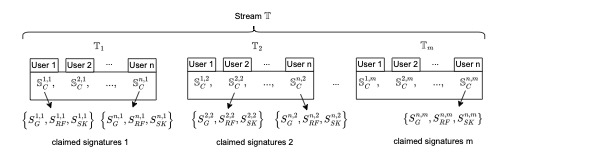
Handwritten Signature Verification (HSV) systems distinguish between genuine and forged signatures. Traditional HSV development involves a static batch configuration, constraining the system's ability to model signatures to the limited data available. Signatures exhibit high intra-class variability and are sensitive to various factors, including time and external influences, imparting them a dynamic nature. This paper investigates the signature learning process within a data stream context. We propose a novel HSV approach with an adaptive system that receives an infinite sequence of signatures and is updated over time. Experiments were carried out on GPDS Synthetic, CEDAR, and MCYT datasets. Results demonstrate the superior performance of the proposed method compared to standard approaches that use a Support Vector Machine as a classifier.
5
Label noise detection under the noise at random model with ensemble filters

Label noise detection under the noise at random model with ensemble filters

Kecia G. Moura, Ricardo B. C. Prudêncio, George D. C. Cavalcanti

Intelligent Data Analysis, vol. 26, no. 5, pp. 1119-1138 2022 Journal DOI
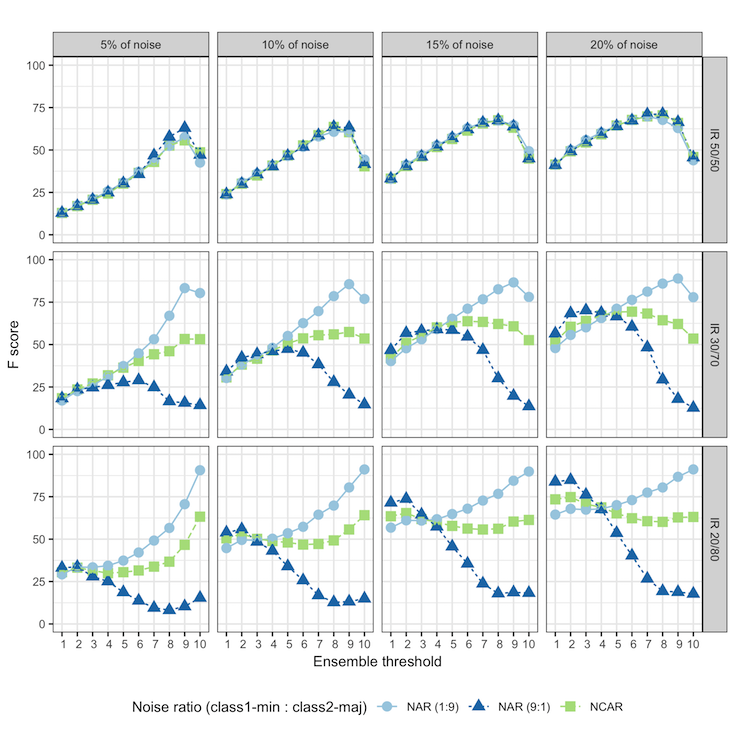
Label noise detection has been widely studied in Machine Learning because of its importance in improving training data quality. Satisfactory noise detection has been achieved by adopting ensembles of classifiers. In this approach, an instance is assigned as mislabeled if a high proportion of members in the pool misclassifies it. Previous authors have empirically evaluated this approach; nevertheless, they mostly assumed that label noise is generated completely at random in a dataset. This is a strong assumption since other types of label noise are feasible in practice and can influence noise detection results. This work investigates the performance of ensemble noise detection under two different noise models: the Noisy at Random (NAR), in which the probability of label noise depends on the instance class, in comparison to the Noisy Completely at Random model, in which the probability of label noise is entirely independent. In this setting, we investigate the effect of class distribution on noise detection performance since it changes the total noise level observed in a dataset under the NAR assumption. Further, an evaluation of the ensemble vote threshold is conducted to contrast with the most common approaches in the literature. In many performed experiments, choosing a noise generation model over another can lead to different results when considering aspects such as class imbalance and noise level ratio among different classes.
6
Ensemble methods for label noise detection under the noisy at random model

Ensemble methods for label noise detection under the noisy at random model

Kecia G. de Moura, Ricardo B. C. Prudêncio, George D. C. Cavalcanti

2018 7th Brazilian Conference on Intelligent Systems (BRACIS), pp. 474-479 2018 Conference DOI
Label noise detection has been widely studied in Machine Learning due to its importance to improve training data quality. Effective noise detection has been achieved by adopting an ensemble of classifiers. In this approach, an instance is assigned as mislabeled if a high proportion of members in the pool misclassifies that instance. Previous authors have empirically evaluated this approach with interesting results, nevertheless, they mostly assumed that label noise is generated completely at random in a dataset. This is a gap in the literature since there are other types of label noise which are feasible in practice and can influence noise detection results. This paper investigates the performance of ensemble noise detection in a different noise model, the Noisy at Random (NAR) model, in which the probability of label noise depends on the instance class. In this setting, we also investigate the effect of class distribution on noise detection performance, since it changes the total noise level observed in a dataset under the NAR assumption. It is shown in a number of performed experiments that the choice for a noise generation model over another can lead to distinct results when taking into consideration aspects such as class imbalance and noise level ratio among different classes.